Safe Days for Sex and Not Getting Pregnant: How to Calculate Your Safe Period
- October 28, 2026
The safe days to have sex are the days of your cycle when pregnancy is less likely, mainly the first days of your period and the days after ovulation until your next period. In a regular 28-day cycle, the fertile days are roughly day 9 to day 16. But no day is 100% safe, and the safe period method fails in about 12 to 24 out of 100 women in a year with typical use. If you do not want a pregnancy, use proper contraception.
Many couples want to enjoy intimacy without worrying about pregnancy, and without using condoms or pills. This is why so many people search for “safe days to have sex”, “safe period for intercourse” and “calculating safe period”. The idea is natural and hormone-free, but it needs a good understanding of your body. This guide explains how it works, how to calculate it, and where it can go wrong.
What Is the Safe Period?
The safe period means the days in your menstrual cycle when you are less likely to get pregnant because they fall outside your fertile window. These are days when the egg has either not been released yet, or has already been released and has passed its short life.
It is better to call them “lower-risk days” than “safe days”. Ovulation does not happen on the same day every month, so a day that is safe in one cycle may not be safe in the next.
How Pregnancy Happens: The Basics
To understand safe days, you need to know three simple facts:
- Ovulation happens when an ovary releases a mature egg. In a typical 28-day cycle, this occurs around day 14, usually about 14 days before the next period.
- An egg remains viable for just 12–24 hours after ovulation.
- Sperm may survive in the reproductive tract for up to five days, meaning sex before ovulation can still cause pregnancy.
For this reason, the fertile window spans approximately six days, including the five days before ovulation, ovulation day, and around one day afterward. Pregnancy is possible only in this window.
Safe Days in a Regular 28-Day Cycle
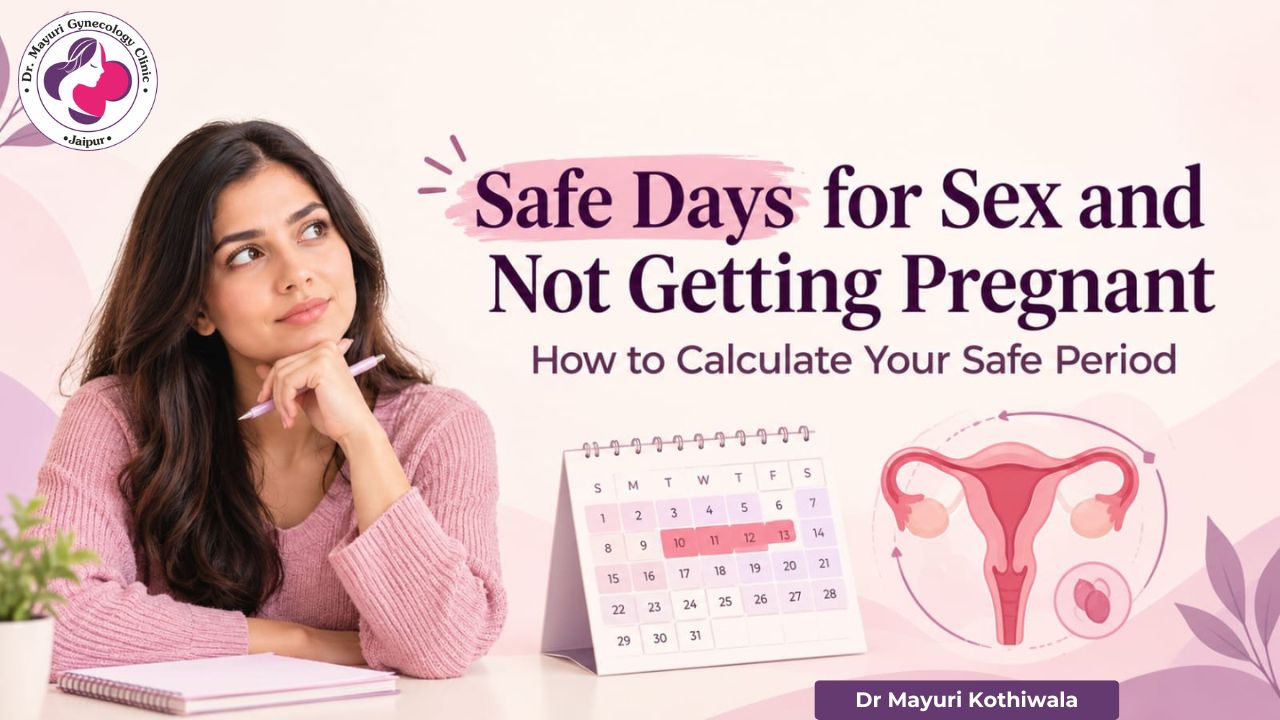
Day 1 is the first day of your period. For a regular 28-day cycle, the days look like this:
Cycle days | Phase | Pregnancy risk |
Days 1 to 7 | Period and the days just after | Lower, but not zero |
Days 8 to 9 | Body moving toward ovulation | Risk starts rising |
Days 9 to 16 | Fertile window | Highest risk |
Days 17 to 28 | After ovulation | Lower, if ovulation has already happened |
Different sources give slightly different day ranges, such as day 9 to 15 or day 10 to 17, because the exact day of ovulation differs from woman to woman. Treat this table as a template, not a rule. Only about 12% of women have an exact 28-day cycle. Most women have cycles between 23 and 35 days, which changes the whole calculation.
Safe Days for Sex Before Ovulation
When: The first 7 days, during your period and soon after.
Why it is lower risk: In a regular 28-day cycle, ovulation is unlikely before day 14, so sex during your period carries a lower chance of pregnancy.
The catch: If your cycle is short, say 21 to 24 days, you may ovulate as early as day 7 to 10. Sperm from sex during your period can still be alive when the egg is released. So the days right after your period are not automatically safe, especially for women with shorter cycles.
What About Sex During Menstruation?
Sex in the safe period during menstruation is usually low risk for pregnancy, but it is not risk-free. Also remember that safe days protect only against pregnancy. They do not protect against sexually transmitted infections (STIs), and some infections can spread through blood.
Safe Days for Sex After Ovulation
When: From about day 17 or 18 until your next period starts.
Why it is the lowest-risk time: Once ovulation has happened and the egg has passed its 12 to 24 hour life, the chance of pregnancy falls sharply for the rest of that cycle. Also, the hormone progesterone is high after ovulation, which makes the mucus at the cervix thicker and harder for sperm to swim through.
The catch: You must be sure that ovulation has already happened. Most women cannot confirm this just by counting days. Guessing is where this method most often fails.
How to Calculate Your Safe Period (Calendar Method)
You need your cycle history for at least 6 months (3 to 6 months is the minimum). Do not depend only on an app. Note the real number of days of each cycle, counting from the first day of one period to the day before the next.
Step 1: Find your shortest cycle and your longest cycle.
Step 2: Find your first fertile day: shortest cycle minus 18.
Step 3: Find your last fertile day: longest cycle minus 11.
Step 4: Count these days from the first day of your current period. Mark them on a calendar. Avoid unprotected sex on all the days between the first and last fertile day.
Example: Your cycles range from 26 to 32 days.
- First fertile day = 26 − 18 = day 8
- Last fertile day = 32 − 11 = day 21
- Your fertile window is day 8 to day 21. Days before day 8 and after day 21 are the lower-risk days.
You can see how wide this window is. That is why this method is not very precise, even when done carefully. The calendar method is best used as a tool to understand your body, not as a strong way to prevent pregnancy.
Ways to Make Tracking More Accurate
- Basal body temperature: Your resting temperature rises slightly after ovulation. Tracking it daily shows when ovulation has happened.
- Cervical mucus: Around ovulation, mucus becomes clear and stretchy, like raw egg white.
- Ovulation predictor kits (OPK): Urine strips that detect the hormone surge before ovulation.
- Period tracking apps: They estimate your fertile window from past cycles. They only estimate ovulation, they do not confirm it.
Using more than one method together is more reliable than the calendar alone. Fertility awareness works well only with proper training and consistent practice.
Can You Get Pregnant in the Safe Period?
Yes. Pregnancy can happen even in the days called safe, because:
- Ovulation can come earlier or later than expected, even in regular cycles
- Sperm can survive for several days
- Short or irregular cycles shift the fertile window
- Stress, illness, medicines and hormonal changes can delay or bring forward ovulation
A study cited by The Lancet Global Health reported typical-use failure of fertility awareness methods of up to 20%.
How Accurate Is the Safe Period Method?
It depends on how carefully you use it and how regular your cycle is.
- With perfect use, which means regular cycles, steady tracking and confirmed ovulation, it can work moderately well.
- With typical use, it fails in about 12 to 24 out of 100 women in a year, which means roughly 1 in 8 women may become pregnant.
- Methods such as an IUD or implant have failure rates well under 1%, and pills and condoms are much more reliable when used correctly.
So the safe period method is much less reliable than other contraceptives.
Conclusion
The safe period can help you understand your cycle, but it is not a dependable way to avoid pregnancy. The days around ovulation carry the highest risk, the days after confirmed ovulation carry the least, and the days just after your period are not guaranteed safe. If you want to avoid pregnancy, choose a reliable contraceptive, and consult a gynecologist to find the method that suits you. For help understanding your cycle, irregular periods or choosing the right contraception, book a confidential consultation with Dr. Mayuri Kothiwala, Consultant Obstetrics & Gynecology, at Dr. Mayuri’s Gynecology Clinic, Jaipur.
Frequently Asked Questions
What are the safe days to have sex without getting pregnant?
The lower-risk days are the first days of your period and the days after ovulation until the next period. No day is completely free of risk.
What are the safe days in a regular 28-day cycle?
Days 1 to 7 and from about day 17 to day 28 are lower risk. Days 9 to 16 are the fertile window.
Is sex during menstruation safe?
Pregnancy is less likely but still possible, while sexually transmitted infections can continue to spread.
How do I calculate my safe period?
Track at least 6 cycles. Subtract 18 from the shortest cycle and 11 from the longest cycle to find your fertile window.
How accurate is the safe period method?
With typical use, it fails in about 12 to 24 out of 100 women each year.
Are safe days the same for every woman?
No. They depend on your cycle length, regularity and ovulation day, and can change from month to month.