
How to Check Pregnancy at Home: Test Kits, Results and Tips for Confirmation
- October 20, 2026
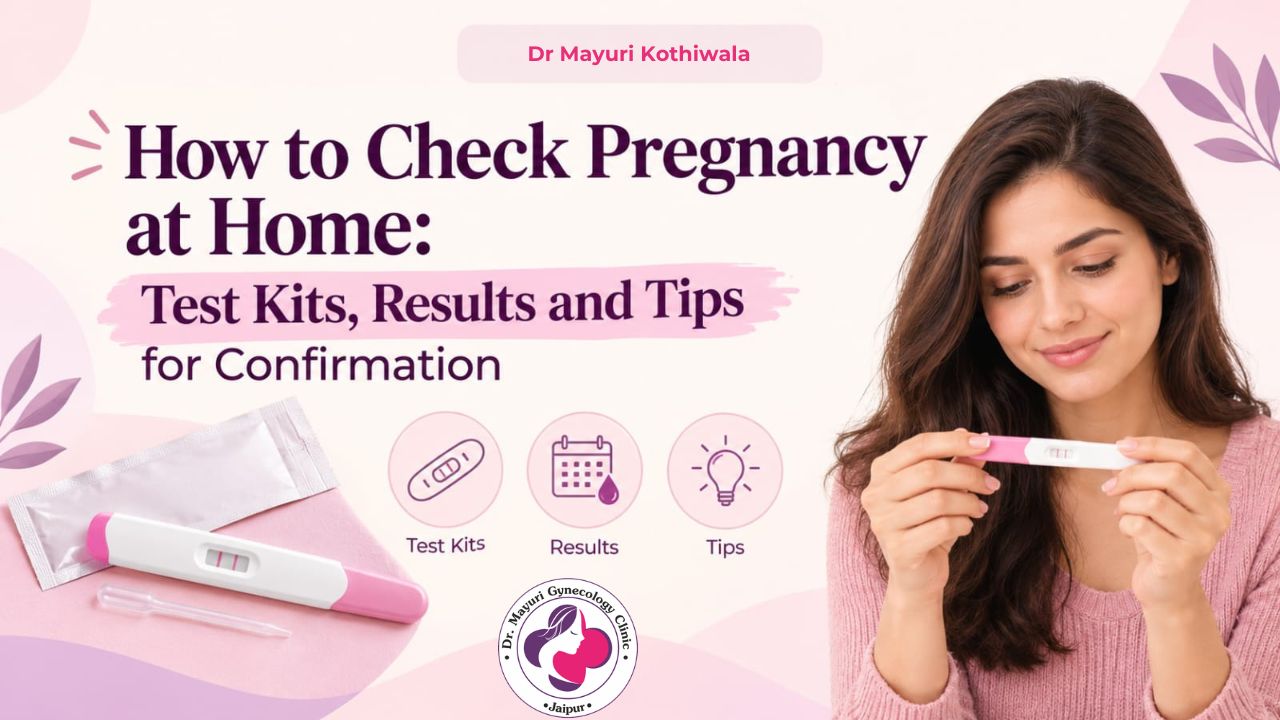
The reliable way to check pregnancy at home is a urine pregnancy test kit. The test identifies beta-hCG, a hormone associated with pregnancy, in the urine. Use the first morning urine, put only 2 drops in the round well (or follow your kit’s steps), and read the result in the time given in the instructions. Two lines (C and T) mean positive. Always confirm a positive result with a doctor and an ultrasound.
Many women want to know if they are pregnant before visiting a clinic. A home pregnancy test is private, quick and cheap, and it is the first step in pregnancy detection at home. This guide explains how to do it correctly, how to read the result, and what to do next.
How Does a Home Pregnancy Test Work?
When a baby starts to develop in the uterus, it attaches through the placenta. The placenta releases a hormone called beta hCG (human chorionic gonadotropin) into the blood and the urine. Urine pregnancy kits detect this hormone.
Urine pregnancy tests can detect about 95 to 97% of pregnancies and are safe and low-cost. When used correctly, most home tests are about 99% effective, similar to the accuracy of tests done in a doctor’s office.
When Is the Best Time to Test?
- Regular periods (28, 30 or 35 days, roughly fixed): The test can turn positive by the expected date of your period.
- Irregular periods: Results can vary. If cycles are short, the test may be positive earlier. If cycles are long, it may take longer.
- Too early: hCG can be detected about 10 days after conception, but a missed period (about 14 days after conception) lowers the chance of a false negative. If you test before your period is due, the line may be faint.
How to Do a Urine Pregnancy Test at Home: Step by Step
- Check the expiry date and the box. Do not use an expired or damaged kit.
- Read the instructions that come with your kit. Kits differ slightly.
- Use your first morning urine. It has the most concentrated hCG. If you test later in the day, hold your urine for at least 3 hours first.
- Do not drink excess fluids before the test. They can dilute the hormone.
- Apply the sample as directed. There are three common ways:
- Collect urine in a clean, dry cup and place a few drops on the test.
- Hold the test strip in your urine stream for a few seconds.
- Dip the strip in the cup of urine up to the marked level.
- For a kit with two windows: A round well and a rectangular window are common. Put urine drop by drop only in the round well. Two drops are enough, so do not overflow it. The urine will slowly travel across the rectangular window.
- Lay the kit flat and wait for the time written in the manual, usually 3 to 5 minutes.
- Read the result on time. Reading too early or too late can cause confusion.
You do not need to visit the hospital to repeat the test. It can easily be done again at home.
How to Read Your Pregnancy Kit Test Results
The window has two letters: C (control) and T (test). The C line is a built-in check that the kit is working, so it should always appear.
Positive: The T line is dark pink and thick, similar to the C line. This means beta hCG is present and you are most likely pregnant.
Faint positive: The T line is pink but lighter and thinner than the C line. This can mean:
- The test was done very early, when the pregnancy is small
- Your periods are irregular, with a history of delayed cycles
- The test was done before the expected period date
- An unhealthy pregnancy, such as an ectopic pregnancy (outside the uterus) or one that is not growing properly or is miscarrying
Repeat the test after a week. If there is no bleeding or pain, you can safely wait. In late conception, the line usually gets darker and becomes a clear positive.
Negative: The C line appears alone, while the T line does not appear. Pregnancy is unlikely. If your period is late, repeat the test after a week.
Invalid: No C line appears, or the kit shows no lines at all. The kit is faulty. Repeat the test with a new kit.
What to Do After a Positive or Negative Result
If positive: Contact your gynecologist. A sonography is advised at or after 5 weeks, when the gestational sac first becomes visible. A scan before 5 weeks is not useful. In early pregnancy, the best first scan is a transvaginal scan (TVS). It is painless, more sensitive, and has no side effects. The belief that it causes bleeding or harms the baby is a myth. Sonography uses sound waves and has no radiation.
If your test is negative and your period has not arrived, take another test after seven days. If two tests a week apart are both negative, visit your gynecologist. Medicines may be prescribed to bring back your periods, and the cause of the delay needs checking.
If the urine test is positive but nothing is seen on ultrasound even at 5 and 6 weeks, your doctor may advise a serum beta hCG blood test. It is done twice, 48 hours apart. In a healthy pregnancy, the second value is roughly double the first. A small rise or a fall can mean an ectopic pregnancy or a pregnancy that is not progressing, so it needs medical attention.
Choosing a Good Pregnancy Test Kit
Pregnancy self test kits are available at every medical store. When choosing the best pregnancy check kit, keep these points in mind:
- Select a kit from a reliable brand, ensuring the expiry date is visible and the package is sealed.
- Choose a kit with simple instructions and a clear control line
Types of Home Pregnancy Test Kits
- Strip kits: A thin strip is dipped in the urine up to a marked line.
- Cassette (two-window) kits: Urine drops go in the round well, and the result shows in the rectangular window with the C and T lines.
- Midstream kits: The absorbent tip is held in the urine stream for a few seconds.
- Digital kits: The screen shows words such as “Pregnant” or “Not pregnant”. Follow the pack’s instructions to read them.
All types detect the same hormone, so pick the one you find easiest to read.
Tips for Accurate Pregnancy Kit Test Results
- Take the test when your period is due or afterward; if your cycle is irregular, consider testing a week later.
- For better accuracy, use first-morning urine and avoid consuming excessive water before testing.
- Put only 2 drops in the well. More urine will not make the result stronger.
- Keep the kit flat while it works, and do not move it.
- Read the result within the time given in the manual. A faint line seen long afterwards may not be reliable, so repeat the test with a new kit instead.
- Store the kit in a cool, dry place and never reuse it.
- If you are on infertility treatment with hCG injections, tell your doctor before testing, because the hormone can show up in urine for a few days.
Frequently Asked Questions
What is the most reliable way to check pregnancy at home?
A urine pregnancy test kit used as per instructions.
What does a faint line mean?
It can mean a very early pregnancy, but sometimes an unhealthy pregnancy. Repeat the test after a week and consult your doctor.
My test is negative but my period is late. What should I do?
Repeat after a week. If both tests are negative, see your gynecologist.
Can a Home Test Be Wrong?
- False negative (negative test, but you are pregnant): Most often caused by a faulty kit, a very early test or diluted urine. Repeat after a week.
- False positive (positive test, but no pregnancy): This is uncommon. It can happen with placental tumors (gestational trophoblastic disease) that release hCG, or in women on infertility treatment who recently had hCG injections, since the hormone can show in urine for a few days.
Can an Ovulation Test Kit or Ovulation Strip Be Used as a Pregnancy Test?
No. Ovulation test kits detect a different hormone, called LH (luteinizing hormone), that rises before ovulation. They do not reliably detect hCG, so an ovulation strip should not be used as a pregnancy test. Use a proper pregnancy kit.
Conclusion
A urine pregnancy test kit is the simplest and most reliable way to check pregnancy at home. Use it correctly, read the result on time, and repeat it after a week if the line is faint or your period is late. After any positive result, see a gynecologist and get an ultrasound at or after 5 weeks to confirm a healthy pregnancy.
For pregnancy confirmation, early scans or delayed periods, book an appointment with Dr. Mayuri Kothiwala, Consultant Obstetrics & Gynecology, at Dr. Mayuri’s Gynecology Clinic, Jaipur.